Fundamentals
How machines learn
From hand-written rules to systems that train themselves: the core ideas behind machine learning, neural networks, and the large language models powering today’s chatbots.
01 · The shift
Two ways to tell a computer what to do
Classical programming is a recipe: a human writes explicit instructions, and the machine follows them exactly. That works brilliantly when the rules are known — sorting a list, calculating taxes. But try writing rules for recognizing a cat in a photo, and the project collapses: whiskers may be hidden, lighting varies, breeds disagree, and no one can fully explain how they knew it was a cat at all.
Classical programming
Input plus hand-written rules produces the output. Every behavior was anticipated and coded by a person. Predictable and auditable — and brittle at tasks we cannot fully explain, like vision or language.
Machine learning
Input plus expected outputs produce learned rules — the model. The system generalizes from examples to cases it has never seen. Powerful, but only as good as its data and its training.
Everything on this site — from image classifiers to chatbots — is machine learning. The rest of this page traces how it works, in five steps and one picture.
02 · The engine
The training loop, in five steps
-
Gather data
Collect many examples: labeled photos, text corpora, game positions, sensor readings. Data quality sets the ceiling on model quality.
-
Initialize a model
Pick an architecture — how artificial neurons connect — and fill its parameters (the tunable numbers) with random values. At first, the model is wrong about everything.
-
Measure the error
A loss function compares the model’s prediction with the correct answer and returns a single number: how wrong it was.
-
Nudge the parameters
Gradient descent computes which direction each parameter should move to shrink the error, then takes a small step downhill. The 1986 backpropagation paper (Rumelhart, Hinton and Williams, Nature) made this efficient for deep networks.
-
Repeat, a lot
Modern training runs this loop billions of times over trillions of words of text. The error falls, the patterns emerge, and capability appears.
In one sentence
Training is descent down an error landscape: measure how wrong you are, step downhill, and repeat until good enough.
03 · The architecture
A neural network, visualized
Artificial neurons are tiny calculators: multiply each input by a weight, add the results up, and pass the total through a simple non-linear function. Connect them layer by layer and the magic appears — early layers detect simple features, deeper layers combine them into abstract ones. In images, that means edges, then textures, then objects. In language, it might be characters, then words, then meaning.
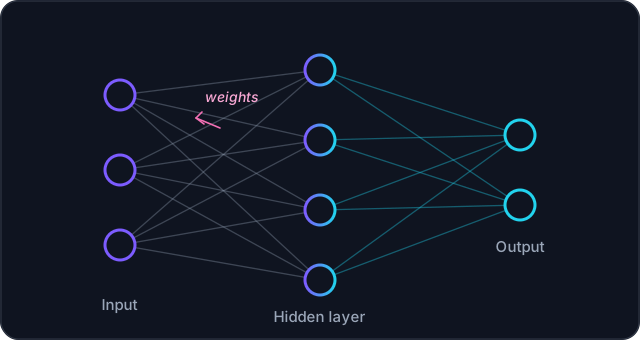
“Deep” learning simply means many layers. Depth is what let networks escape the limits that stalled earlier approaches — and it became practical once GPUs and backpropagation made the gradient computations tractable at scale.
04 · The headline act
From next-word prediction to chatbots
Large language models (LLMs) are the current crown jewels of this recipe. They are trained on a staggering amount of text, chopped into tokens — word fragments the model reads as plain numbers. The training objective is deceptively simple: given the tokens so far, predict the next one.
tokens in → embeddings → attention layers → next-token probabilities → sample → append → repeat
The pivotal idea is attention, introduced in the 2017 paper “Attention Is All You Need” (Vaswani et al.). Instead of reading a sentence word by word, attention lets every token look at every other token and decide what matters — which is how a model can resolve what “it” refers to across a whole paragraph, or keep track of a character over pages of a story.
Prediction alone produces a text-completion engine. Chat behavior comes afterward: fine-tuning on curated dialogues and human-feedback training (RLHF) shape the raw model into an assistant that follows instructions, declines harmful requests, and admits uncertainty — sometimes.
Why chatbots confabulate
An LLM is optimized to produce plausible continuations, not verified truths. When it lacks knowledge, the same machinery can generate fluent, confident nonsense — the “hallucination” problem. Treat outputs as drafts to verify, not answers to trust blindly.
05 · The vocabulary
Key terms, decoded
- Model
- The trained artifact: an architecture plus millions to billions of learned parameter values.
- Parameters
- The internal numbers a model adjusts during training. GPT-3 (2020) had 175 billion of them.
- Training
- The loop of predicting, measuring error, and updating parameters over a dataset.
- Inference
- Using the trained model. Every chat reply is a fresh inference pass.
- Token
- The chunk of text a language model reads: a word, part of a word, or punctuation.
- Attention
- The mechanism that lets a model weigh which earlier tokens matter for the next prediction.
- Fine-tuning
- Continuing training on a smaller, focused dataset to specialize or align a model.
- RLHF
- Reinforcement learning from human feedback: people rank outputs, and the model learns to prefer the preferred ones.
- Multimodal
- Models that handle more than text — images, audio, video — in a single system.
- Hallucination
- A confident but false output; a byproduct of optimizing for plausibility over truth.